By Kris Grant
Ever wonder what it was like to be a kid in Coronado in the days before the bridge, computers and cell phones? We gathered together a group of longtime Coronadans to tell us what life was like in the good old days — and, it turns out, every one of them thought those days were indeed pretty darn special.
The composition of the group around the Coronado Golf Course conference table mirrored the population mix of the city back in 1950: of 16 interviewees, 14 had fathers employed in the Navy, one was the daughter of a local physician, and one was the son of a Hotel Del busboy and later a steward for the Officer’s Club at North Island. Subsequent interviews were conducted with Susan (Ring) Keith and Ky (Winchester) Roberts.
Here are a smattering of impressions, memories and insights of circa-1950s Coronado, a town affectionately termed Mayberry-by-the-Sea by many who grew up here, and live here still.
On play
Imagine a Coronado filled with vacant lots, no traffic lights — not even a single stop sign! The dips at intersections were all that were needed to slow cars down. That’s the way it was back in the 1950s.
“Kids played in the streets,” said Shannon Player, the youngest of seven children. “And there were so many kids! There must have been over 60 in my block, (the 800 block of C Avenue) at the time.”
“There were 13 kids in my family,” Johnson chimed in.
“Lots of families had four kids,” Penny (Emmons) Duermeyer said.
“We didn’t have a television for several years,” said Doug (Mustin) St. Denis. “After dinner, we’d go back outside to play!”
“We played hide-and-seek and kick-the-can,” said Bruce Johnson. “We thought nothing of going onto our neighbor’s property. There was all this tall grass on Alameda and all over town there were vacant lots.
“We’d built forts on them, with tunnels and doors and you’d need to know the secret word to get in.”
Joe Delasalas remembers the days when kids regularly played the now- impolitic game of Cowboys and Indians. “Once, the Indians caught me and tied me to a pole and were ready to burn me at the stake. They gathered a bunch of newspapers around my feet and just as they lit them on fire, my mom came running out. That was the end of that.”
“Bruce and I would catch horny toads and alligator lizards,” said Mike Napolitano, born just hours after Johnson, a lifelong friend.
“Tommy Noonan and I would go down the Strand and shoot rabbits in the 1940s and it went on into the ‘50s,” said John Clampitt “With .22-long rifles.”
In this era before modern technology — even plastic was new on the market — kids found ways to ride the surf and roll down the streets. “We made surfboards out of planks in shop class,” said Tom Kennedy.
“We strapped roller skates onto the bottom of our shoes and tightened them with our ‘skate keys,’” St. Denis added. “No one heard of a skateboard.”
“Football games at the high school were a really big deal,” Delasalas remembered. “If Coronado won, there would be a parade of cars with plenty of honking and yelling that would be led throughout the town by a police car.”
“My favorite memories were of Halloween and it was so big in Coronado,” said Martha (Plumb) Protzman. “We’d line up by the Rotary Christmas tree for costume judging. Then we’d walk all the way to Cutler Field at the high school. We just thought we were kings and queens. We actually dressed up two nights; the 30th was called Beggar’s Night.”
On earning money
Most young boys had paper routes, including Bill Gise, Delasalas, Kennedy, Vince Flynn and Napolitano.
Girls often got babysitting jobs, and the most coveted were those at the Hotel Del. “We’d compare notes to see who got the best deals,” said Vicki (Valliere) Beaubien. “We’d yell across the balcony, ‘how much is your family paying you?’”
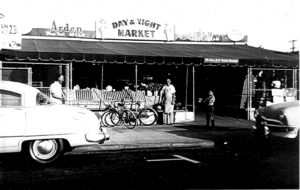
Napolitano also worked at the Day and Night Market, which his grandfather founded and his dad eventually took over. The market was in the 800 block of Orange Avenue where Wells Fargo Bank is today, next door to the popular Bob’s Frosty Wave. “I have so many fond memories of working at the Day and Night,” Napolitano said. “I’d rotate the sodas, load the comic books, but my favorite job was working at the Christmas tree lot, it was like a pine forest right next door to the market and I’d put the stands on the bottom of the trees.”
But not all of Coronado smelled like a pine forest back in the day. Kennedy remembers the smell of rotten fish that would envelop the island every time there was a Santa Ana wind. “Tuna factories dominated the waterfront. But fortunately most of the time, the ocean breeze carried the odor toward the mainland.”
On mischief
“Teenagers get into trouble if they aren’t busy and no one is watching them,” said Patty (Murphy) Jepson. “It’s true today and was true yesterday. We’d flip the power off in people’s electrical boxes and then run and hide in our cars. We’d watch for them to come out of their houses and they’d be spitting mad. And we’d howl in laughter.”
The lure of the Hotel Del called out to all Coronado kids and teens.
Jeanne (Curcio) Bowers remembers, “We used to climb up into the tower, into the turret. And as young teens, we’d get dressed up in tennis whites and get everyone’s autograph on the courts.”
Pat Flynn arrived in Coronado in 1955 and one of the first people she met was Penny (Emmons) Duermeyer. “We’d go to the Hotel Del and climb all over the thing, down in the basement, up on the top deck and then we’d hide and run… until one time we ran right into the arms of the house detective.”
They were given a stern talking to, and sent on their way… until the Del called out to them again, when the movie “Some Like It Hot” was filmed there in 1958.
“Everyone could get up close to the ropes where they were filming,” Kennedy said. “I watched as they covered Marilyn Monroe with umbrellas and spritzed her; it was hot! And Billy Wilder would scream through a megaphone. I got to meet Jack Lemmon.”
“We all were lined up watching every scene,” said Pat Flynn.
The ferry was another big factor in kids’ lives. “There were two places we’d get gear,” said John Clampitt. “One was Ferris surplus, near where the ferry docked in San Diego, and the dump at North Island, where the Navy Lodge is now.”
Plumb remembers riding the ferry and connecting to the bus to ride to Walker Scott Department Store and Woolworth’s in Downtown San Diego. But surprisingly, many of the old-timers agreed that Ferris surplus was the place to shop.
“We’d swim around the fence to get there. We’d get flight jackets and the prize would be a six-man life raft. We used to go surfing with that. And sometimes they had fluorescent dye and it would light up the surf. But it also lit us up; I once turned green and that was all the evidence a cop needed to turn me in.
On Hanging Out
Everybody headed to Oscar’s Drive-in in the Crown Shops, where the Fish Market is today. The circular drive-in was built by Robert Peterson, who later founded Jack in the Box.
“Oscar’s was straight out of American Graffiti,” said Bill Gise. “The car hops were all female and at first wore roller skates. There were only about nine car stalls and they were highly coveted. We’d ‘cruise Oscar’s’ which meant we’d do a loop, up and down Orange Avenue, down to North Beach, back to Oscar’s.”
Protzman added, “We’d tell our parents we were going to the library. So I’d put my foot in the library and then head on down to Oscar’s. The cops would drive through Oscar’s and then follow us to find the party houses.”
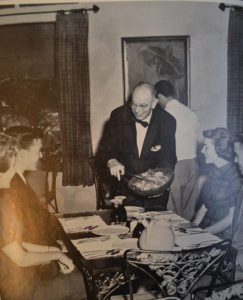
Betty (Mott) Reynolds remembers the soda fountain at Central Drug and St. Denis remembers you could order up a delicious tuna on toast there. Vince Flynn remembers the Luau Room at the Hotel Del. “That’s where we’d go to dance with visiting college girls,” he said. “It had this South Pacific vibe.” Pat Flynn spent many birthday dinners with her family at the Luau Room, and both the Flynns were patrons at La Avenida, famous for Jack’s Caesar Salad. Reynolds said teenagers often trekked down to “Brickyard Cove” to build bonfires. “And we used to go horseback riding on the island. The stable was in the country club area and you could ride all around the island. Kennedy added: “We had a house that was four doors down from the North Island gate, and the bridle path went through our backyard.”
On Pop Millar
Back in the ‘40s, a juvenile police officer, Shelby E. Millar, Sr., affectionately known as Pop Millar, was like a modern day Pied Piper to Coronado kids.
“We’d all meet at the library and Pop would march us down to the theater for a free Saturday morning movie,” said Vince Flynn.
“It was our reward for community work,” said Delasalas. “I still have a certificate for being with the safety patrol.”
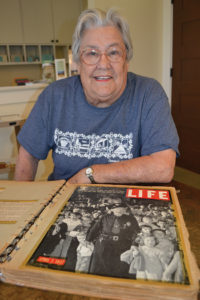
But, in truth, just about any kid in Coronado could follow Pop to the movies, said Susan Keith. Millar was written up in the April 7, 1947 issue of Life magazine, now stored in the Coronado Historical Association archives. “Someone pasted up the story to look like he was on the cover, but the story actually ran on the inside,” Keith said. “But to all of us, he was cover-worthy.”
On change:
The most dramatic changes came with the opening of the Coronado Bridge in August 1969. “Most people came out of their shoes to stop that bridge,” said Johnson. “But it was pushed through by Hotel Del owner Larry Lawrence and former governor Pat Brown, who argued that he had the authority to build it without public input.”
Before the bridge was built, families never locked their homes, agreed all interviewees, in sharp contrast to today’s Coronado, where electronic police signs read: “Lock your house; Lock your car!”
“Sadly, today, not only do I lock my house, I have a security system,” said Keith.
A final show of hands: Were we safer back in the day?
All hands shot up.
“It was a happy time,” said Player. “We had carefree freedom and a sense that our parents trusted us.” Ky Roberts adds, “Coronado’s my home. Even when I lived elsewhere, there wasn’t a year that went by, that I didn’t visit here. Now I’m back where I started. I love it and I’m staying; Coronado makes me happy.”
captions
Looking back to their early years in Coronado are (back row, from left) John Clampitt, Tom Kennedy, Martha (Plumb) Protzman, Bruce Johnson, Mike Napolitano, Penny (Emmons) Duermeyer; second row: Bill Gise, Vicki (Valliere) Beaubien, Shannon Player, Joe Delasalas, Betty (Mott) Reynolds, Vince Flynn; front row, Patty (Murphy) Jepson, Jeanne (Curcio) Bowers, Doug (Mustin) St. Denis, Pat (Moyle) Flynn.
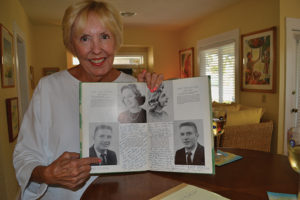
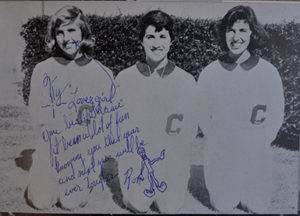
Coronado High School, circa 1957
The Luau Room at the Hotel del Coronado, with its South Pacific atmosphere, was a popular spot for dancing and special events